


Avoid Fines: U.S. Brake Light Strobe Rules, Specs and 6 Step Install
Brake light strobe modules do make a vehicle more noticeable in traffic, but their street legality in the United States depends on how your state reads FMVSS No. 108 and its own vehicle code. The safest move is picking a module that flashes briefly and then locks into steady illumination, checking DOT/SAE markings and an IP65 or better weatherproof rating, and confirming your state allows aftermarket brake signal strobes before you wire anything in. Some vendors sell DOT/SAE-flagged strobe options built for exactly this kind of scrutiny.
TL;DR:
- Most brake light strobe modules operate within a 12V to 24V range and should have specified flash frequency, load capacity, and IP rating listed on the product.
- State laws vary widely, so verify your local vehicle code and look for DOT or SAE markings before installing any aftermarket strobe, especially on street-driven vehicles.
- Installing a module is quick if using a plug-and-play harness, but a proper splice requires identifying the brake wire, grounding correctly, and fitting an inline fuse to ensure safety and legality.
- Limiting the flash pattern to four to six pulses before steady illumination enhances visibility while reducing legal and safety risks associated with continuous flashing.
- Higher-rated waterproof housings and DOT/SAE-approved patterns ensure durability and legal compliance, especially for commercial or construction applications.
Table of Contents
- How Does a Brake Light Strobe Actually Work?
- Is a Flashing Brake Light Legal in Your State?
- What Do You Need to Install a Strobe Module?
- Do the Safety Benefits Outweigh the Risks?
- Which Aftermarket Brake Strobe Is Right for Your Vehicle?
- How Do You Install It: Tools and Troubleshooting?
- How Long Does This Actually Take Start to Finish?
- What Will This Cost You, Really?
- How Do You Choose the Right Strobe Module?
- What Red Flags Should Make You Walk Away?
- Why We Build Around DOT‑Oriented, Weatherproof Strobes
- Recommended All Star Truck Parts Strobe Products
- Sources
- FAQ
How Does a Brake Light Strobe Actually Work?
A brake light strobe module sits between your brake switch and your existing brake lamp, intercepting the signal and turning a normal “on/off” brake light into a flashing brake light with a programmed sequence. Most units run on a 12V to 24V range, which covers everything from a pickup to a Class 8 tractor, and each one carries a maximum load rating in amps or watts that you cannot exceed without risking a blown fuse or a fried module.
The typical pattern is a handful of rapid flashes, usually four to six, followed by a hold on steady illumination. That’s not arbitrary. Kahtec’s Smart Stop technology is built around the idea that a quick attention-grabbing flash followed by a steady hold gets noticed faster than a plain brake light, without leaving the driver behind you guessing whether you’re braking or signaling something else.
Pro Tip: If a module’s spec sheet doesn’t list a flash frequency in Hz or a flash duration in milliseconds, treat that as a red flag. Reputable manufacturers publish these numbers because installers and inspectors both ask for them.
When you’re comparing an LED brake light strobe against an older incandescent flasher, check these fields on the spec sheet:
- Flash frequency (Hz) and total flash count before steady-on
- Maximum load in amps or watts at your vehicle’s voltage
- IP rating for water and dust resistance
- Warranty length, since LED drivers fail faster in modules without one
SuperBrightLEDs’s product listings show the pattern clearly: voltage range, max load, IP rating, and mounting style are the four data points nearly every serious brake signal strobe seller lists up front. If a listing skips two or three of those, keep shopping.
Is a Flashing Brake Light Legal in Your State?
FMVSS No. 108 doesn’t hand down one clean rule that says “flashing brake lamps are legal” or “illegal.” Instead, it regulates lamp function, color, and location, and it cares a great deal about whether a signal could be mistaken for authorized emergency vehicle lighting. That ambiguity is exactly why so many aftermarket flashing brake light kits carry a “show or off-road use only” label. Manufacturers use that disclaimer to shift compliance responsibility onto the buyer rather than certify the part for street use everywhere.
Signal Dynamics’s product documentation puts it plainly: aftermarket strobe and flasher modules may conflict with the intent of FMVSS No. 108, and the company tells buyers to check both federal and local rules before installing on a street-driven vehicle. That’s not boilerplate. States write their own vehicle codes on top of the federal floor, and they don’t agree on brake light flasher module legality.
Before you install anything, walk through this checklist:
- Pull up your state’s vehicle code section on lighting equipment, not just a summary blog post
- Call or check your state DMV’s equipment guidance if the statute language is vague
- Look for DOT or SAE markings stamped directly on the lens or housing
- Confirm the module isn’t marketed with emergency-style colors (red and blue combinations draw the most legal scrutiny)
Pro Tip: Fleet operators should treat this as a compliance decision, not a preference call. A single non-compliant flashing brake light on a commercial trailer can turn into an out-of-service violation during a roadside inspection, which costs far more than the module itself.
What Do You Need to Install a Strobe Module?
Two installation paths cover almost every brake light strobe on the market: inline splicing into your existing brake circuit, or a plug-and-play harness that taps into your factory connector without cutting a single wire. Plug-and-play variants cost a little more but save time and avoid the risk of a bad splice on a wire you’ll never see again once the housing is buttoned up.
Here’s the sequence that keeps installs clean:
- Identify the brake switch wire and a solid chassis ground before you touch anything.
- Confirm your vehicle’s voltage (12V for most light trucks, 24V for many heavy trucks) matches the module’s rated input.
- Check whether your vehicle has a separate CHMSL (center high-mounted stop lamp) circuit, since some strobe kits are designed specifically for that third brake light rather than the main pair.
- Mount the housing where it stays sealed against road spray, using the manufacturer’s gasket or bracket.
- Wire in an inline fuse sized to the module’s max load rating, not your vehicle’s main fuse block rating.
- Test the flash-to-steady transition at idle, then again while driving, to confirm timing looks right in daylight and at night.
LED brake light strobe modules run cooler than incandescent equivalents, so heat isn’t usually the failure point. Compatibility is. A module rated for a 12V passenger truck will not behave correctly, or safely, wired into a 24V commercial trailer circuit.
Pro Tip: After installation, watch for any dash warning lights related to bulb-out detection. Some factory bulb-check systems misread a strobing signal as a burned-out bulb, which can trigger a false error on newer trucks.
Do the Safety Benefits Outweigh the Risks?
The case for a brake signal strobe rests on one behavioral fact: a moving flash pattern captures a following driver’s attention faster than a static light, especially in a driver’s peripheral vision. Kahtec’s own product data points to reduced rear-impact risk tied specifically to that quick-flash-then-hold-steady sequence, which is why nearly every reputable emergency brake light strobe and towing strobe on the market follows the same basic rhythm rather than flashing continuously.
The risk side is just as real. A strobe that never settles into steady illumination leaves the driver behind you unsure whether you’re braking, signaling a hazard, or running some kind of aftermarket light show. That confusion is worse in heavy stop-and-go traffic, where a constantly flashing brake light adds visual noise instead of clarity, and it’s part of why red-and-blue combinations draw extra scrutiny from law enforcement who worry about emergency-light mimicry.
A few working rules keep strobes on the safe side of that line:
- Cap the rapid-flash count at four to six pulses, then transition to steady
- Avoid stacking a strobe pattern with hazard lights running simultaneously
- Skip red-and-blue combination strobes for anything used regularly on public roads
- Choose DOT/SAE-flagged products where your state recognizes those markings
Some strobe lineups are built around that same flash-then-steady logic, with leak-proof housings and IP65-rated sealing that hold up in the kind of stop-and-go highway spray that kills cheaper units within a season.
Which Aftermarket Brake Strobe Is Right for Your Vehicle?
Aftermarket brake light strobes split into three practical categories, and price tracks pretty closely with what you’re protecting.
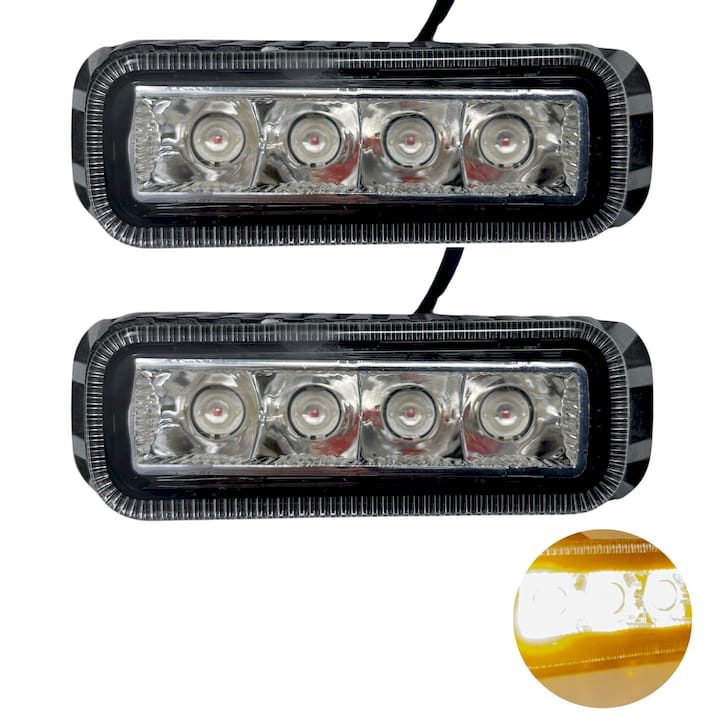
Compact single-lamp strobes, the kind you’d add to a pickup or work van, tend to run in the lower price bracket and focus on one job: making your existing brake light pull double duty as an attention-getter. The 4" x 1.5" rectangle LED amber strobe fits this tier, with an IP65 rating, a 12W draw across four LEDs, and six built-in flash patterns for a 10V to 30V system, which covers both light-duty and medium-duty trucks.
Mid-size towing strobes step up the light output for trailers and towing rigs that need visibility from further back. The 6" x 4" rectangle 6 LED amber strobe sits here, running the same 10V to 30V range with a six-flash pattern and a larger lens for towing safety applications.
At the top end, dual-color high-visibility units target construction and security use rather than everyday street driving. The 5.5" x 4" rectangle 30 LED red and blue strobe carries DOT/SAE approval, an iron and metal mounting bracket, anti-shock and anti-fog protection, and ships as a two-pack, which matters for reliability since you’re rarely running just one unit in a construction or security setup.
How Do You Install It: Tools and Troubleshooting?
You’ll need a wire stripper, a set of butt connectors or a soldering iron, electrical tape or heat-shrink tubing, a test light or multimeter, and an inline fuse holder sized to the module’s rated load. Most installs take under an hour once you’ve located the brake switch wire.
Start by disconnecting the battery. Locate the brake circuit at the existing brake lamp housing rather than digging into the fuse box, since that’s the cleanest tap point for either a splice or a plug-and-play harness. Connect the module’s power lead to that brake wire, ground the negative lead to bare metal on the chassis, and route the output to your lamp.
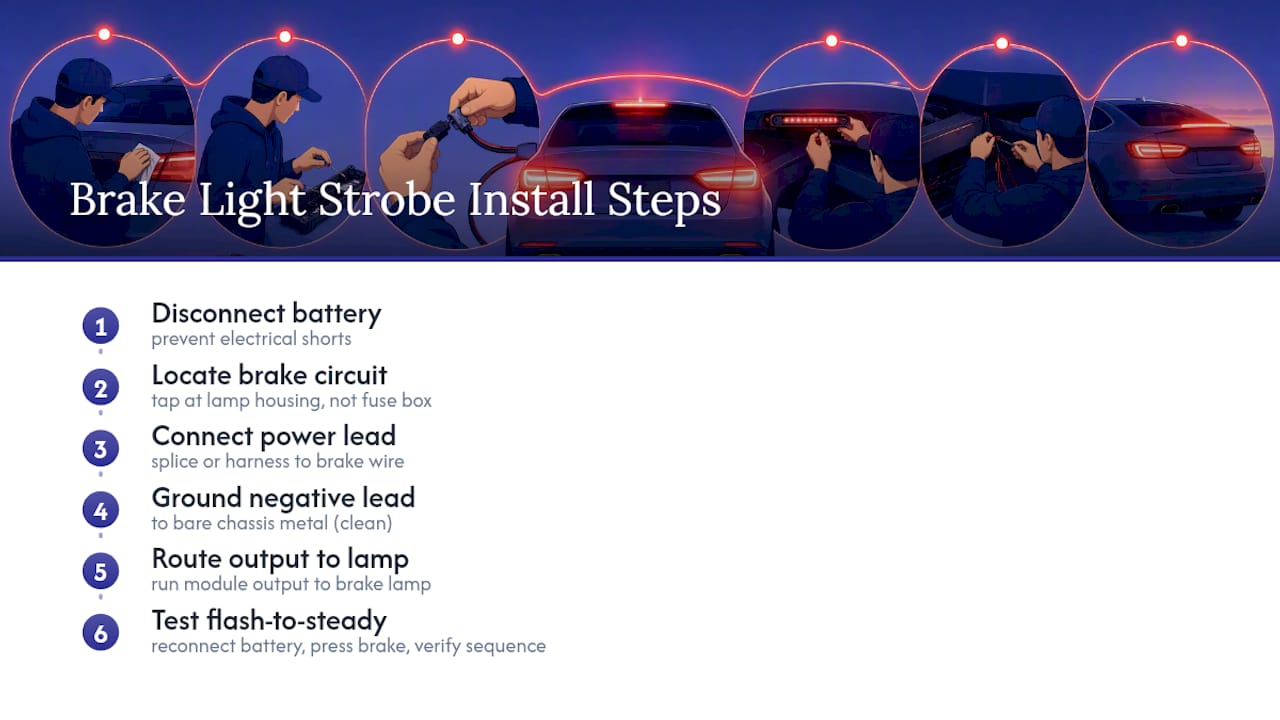
Before sealing anything, reconnect the battery and test with the engine off: press the brake pedal and confirm you see the flash-to-steady sequence, not a single flash or a stuck-on strobe. If nothing happens, check your ground connection first. That’s the single most common failure point in DIY installs. If the light stays on constantly without flashing, the module likely isn’t wired to the correct polarity, or you’ve grounded through a painted surface that isn’t making real contact with bare metal.
Once it tests clean, seal every connection with heat-shrink tubing or dielectric grease, mount the housing so water can’t pool against the seal, and do a final road test at night to check flash visibility against oncoming headlight glare.
How Long Does This Actually Take Start to Finish?
Order a strobe module today and you’re realistically looking at two to five business days for standard shipping before it arrives. That’s the biggest variable in the whole timeline, not the install itself.
Once the part is in hand, installation runs anywhere from 30 minutes for a plug-and-play harness on a factory CHMSL circuit to about 90 minutes for an inline splice job on an older vehicle without a dedicated brake wire you can easily identify. Add another 15 to 20 minutes if you’re mounting a two-pack unit like the red and blue combination strobe, since you’re wiring and sealing two housings instead of one.
Budget a full day if this is your first electrical install and you want to verify state legality first. Reading your state’s vehicle code section on lighting, or calling your DMV’s equipment line, takes longer than the wiring does for most people. Realistically, from the moment you click “buy” to a fully tested, road-legal installation, most drivers land somewhere between three and six days, mostly waiting on shipping and squeezing in an hour of garage time on a weekend.
Fleet installs move faster once you’ve done one unit, since the wiring pattern repeats across a lineup of trucks or trailers.
What Will This Cost You, Really?
A single compact strobe module like the 4" x 1.5" amber unit runs in the same general price bracket as a standard replacement brake lamp, and the larger towing and dual-color units cost more because of the added LED count and mounting hardware. Beyond the part itself, factor in a few dollars for an inline fuse, connectors, and heat-shrink tubing if your kit doesn’t include them.
Labor is the real variable. Do it yourself with basic tools and it costs you nothing but an hour of garage time. Pay a shop to install it and you’re covering their standard electrical labor rate, which varies widely by region and by whether they’re splicing into existing wiring or running a plug-and-play harness.
The warranty question matters more than most buyers realize. Splicing into your vehicle’s factory wiring harness can, in some cases, affect coverage on that specific circuit if a dealer decides the modification caused a later electrical fault. Plug-and-play harnesses that tap a factory connector without cutting wires generally leave less room for that argument, which is one more reason to favor them on a newer vehicle still under warranty.
Weigh the module’s own warranty too. A strobe with a one-year warranty against water intrusion or LED failure is worth more than a slightly cheaper unit with no warranty at all, especially on a trailer that lives outdoors year-round.
How Do You Choose the Right Strobe Module?
Start with voltage and load, not looks. Confirm your vehicle or trailer runs 12V or 24V, then check that the module’s rated max load in amps or watts fits comfortably under what your brake circuit can supply. A module rated tight against your circuit’s limit is a fuse blowout waiting to happen.
Ask these questions before you buy:
- Does this module carry a DOT or SAE marking, or is it labeled show/off-road only?
- What’s the IP rating, and does it match where the light actually mounts (exposed rear bumper versus a protected cab position)?
- How many flash patterns does it offer, and can you lock it to a flash-then-steady sequence rather than continuous flashing?
- What’s the maximum amp or watt load, and does that fit your circuit?
- Is there a warranty, and does it cover water intrusion specifically, not just LED failure?
- Does the listing include a spec sheet with flash frequency and duration, or just marketing photos?
Fleet buyers should add one more question: does the manufacturer sell in the volume and consistency needed for a multi-truck rollout, or is this a one-off retail listing that might change specs between orders? That consistency matters more for commercial buyers than for a single pickup owner.
What Red Flags Should Make You Walk Away?
The most common problem in this market isn’t a bad product. It’s a listing that hides basic information a buyer needs to make a legal, safe purchase.
Watch for these warning signs:
- No voltage range listed, or a vague “universal fit” claim with no amp or watt rating
- Zero mention of IP rating on a light marketed for outdoor or towing use
- Stock photos only, with no spec sheet, no flash pattern description, and no warranty terms
- Red and blue color combinations sold without any DOT/SAE documentation, marketed for general street use
- Reviews mentioning early water intrusion or LED failure within the first few months
- A seller that can’t answer a direct question about show/off-road labeling status
That last point deserves attention. A legitimate manufacturer will tell you plainly whether their product is street legal in your state or restricted to off-road and show use. A seller who dodges that question, or insists their product is “legal everywhere,” is giving you marketing language instead of the compliance answer FMVSS No. 108 and your state code actually require you to check yourself.
Why We Build Around DOT‑Oriented, Weatherproof Strobes
Some suppliers lean toward DOT and SAE compliant strobe options because guessing wrong on lighting law costs drivers more than the part itself, in fines, failed inspections, or worse. Their catalogs may favor leak-proof housings and high-intensity reflectors that hold up past the minimum federal standard, built from feedback across many drivers who need lights that survive real highway conditions, not showroom lighting.
If you’re unsure whether a specific strobe pattern is legal on your route, verify your state’s code first, then reach out to our technical support team with your exact vehicle and voltage details before you order.
— All
Recommended All Star Truck Parts Strobe Products
If you’ve made it this far, you already know the two things that matter most: a compliant flash pattern and a housing that survives weather, not just a bright light. Some providers build strobe lineups specifically for drivers who need both, without gambling on a listing that skips the spec sheet.
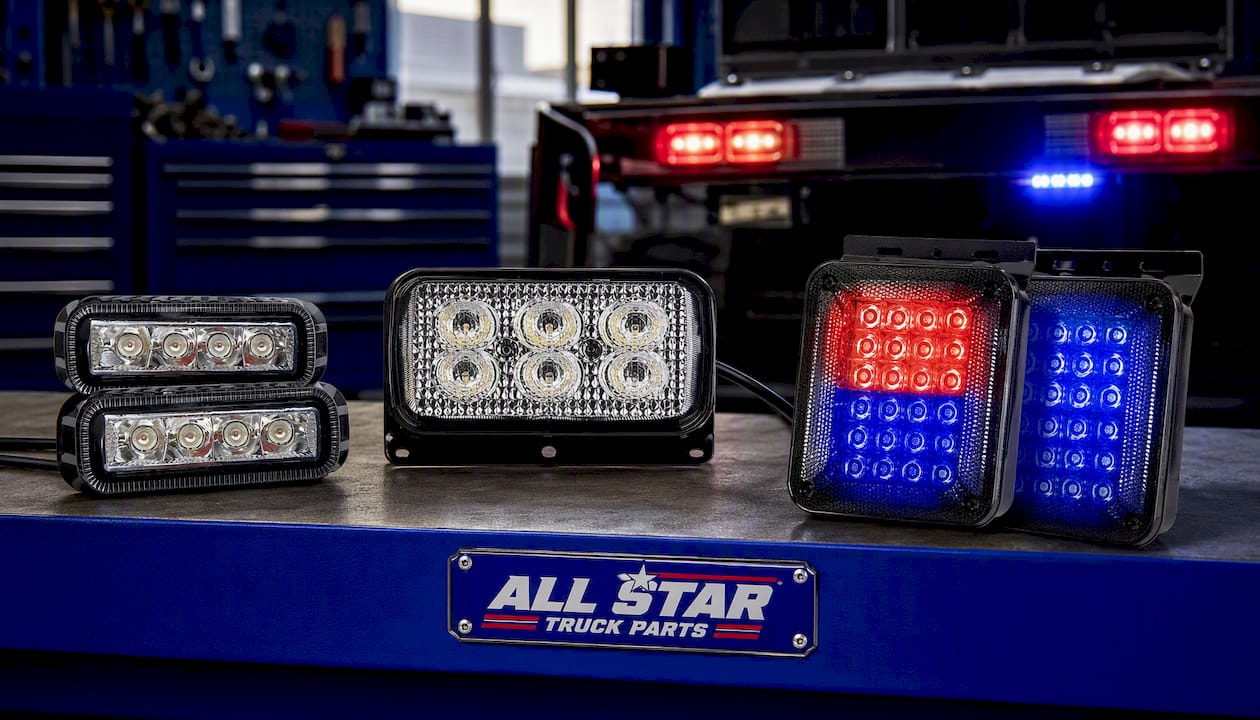
The 4" x 1.5" rectangle LED amber strobe is the pick for compact applications: IP65-rated, 12W across four LEDs, six flash patterns, 10V to 30V compatible. For towing rigs that need more visible mass, the 6" x 4" rectangle amber strobe steps up to six LEDs in a larger housing on the same voltage range. And for construction or security use where dual-color visibility matters most, the 5.5" x 4" red and blue strobe two-pack carries DOT/SAE approval with an iron and metal mounting bracket built for rough duty.
Before you buy, match the voltage to your vehicle, confirm the mount style fits your surface, and check whether your wiring setup calls for a splice or a plug-and-play harness. And be honest with yourself about legality: some of these patterns remain labeled for show or off-road use depending on your state, so check your local code before you wire one into a daily driver. Browse the full lineup on Allstartruckparts and pick the strobe that matches your voltage, mounting style, and local rules.
Sources
- Smart Stop Features – Kahtec Technologies International – Home Of The Flashing Brake Light
- Signal Dynamics — Auxiliary strobe & stop lamp (manufacturer product/regulatory note)
FAQ
Are Strobe Brake Lights Legal in the United States?
It depends on your state. FMVSS No. 108 sets the federal baseline for lamp function and color, but it doesn’t issue one blanket rule on flashing brake lamps, so states write their own restrictions on top of it. Check your state’s vehicle code and look for DOT/SAE markings on the product before installing one on a street-driven vehicle.
Is It Legal to Have a Flashing Brake Light?
In some states, yes, provided the module isn’t styled or colored in a way that could be mistaken for emergency vehicle lighting. Many aftermarket units carry a “show/off-road use only” label specifically because manufacturers want buyers to verify their own state’s rules rather than assume nationwide legality.
Is There a Third Brake Light Strobe Mount Available?
Yes. Several brake light flasher module kits are built specifically for the CHMSL, or center high-mounted stop lamp, rather than the main brake lamp pair, and installers should confirm which circuit their kit targets before wiring it in. If your vehicle has a separate CHMSL connector, a plug-and-play harness designed for that circuit is usually the cleaner install.
Why Are Flashing Brake Lights Illegal in Some Places?
Regulators worry about two things: confusing following drivers about whether you’re braking or signaling something else, and creating a pattern that resembles authorized emergency vehicle lighting. That ambiguity around intent and color is why compliance depends on the specific module and state rather than one universal answer.
What Should I Check Before Buying a Brake Light Strobe Module?
Confirm the voltage range matches your vehicle, check the maximum amp or watt load against your brake circuit, and look for an IP rating suited to outdoor mounting. Allstartruckparts lists these specs directly on its DOT/SAE-flagged products so you’re not guessing before you order.
Recommended
- DOT Compliant 16 LED Jeep style Universal Tail Brake Turn Stop Back up
- 5.5" x 3" Rectangle 21 LED Red + Blue Strobe Light Metal Mounting Bracket
- Stud Mounted 15 LED Trailer Towing Light Set Red/Amber (Stop Turn Tail)
- 4.125" Round Double-Face, Red/Amber, Stud Mount Pedestal Fender Stop Turn Tail Light
